
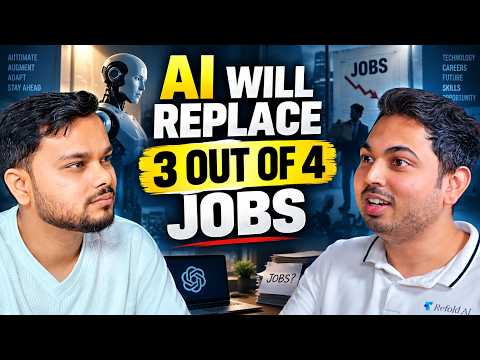
Which Jobs Are Most at Risk From AI?
AI is no longer a distant threat to the job market. It is actively reshaping roles across sectors, and according to Jugal Achaliya, the impact is already visible in specific, measurable ways.
Customer Support Was the First to Change
Call centers, especially in outsourcing hubs like India, were among the earliest functions disrupted by AI.
Voice agents can now hold real time conversations in a caller's native language, complete with natural pauses and emotional tone, making it difficult to tell whether you are speaking to a human or a machine.
Unlike a human agent trained on a knowledge base and available for fixed hours, AI carries the entire knowledge base already, can handle complex queries instantly, and works around the clock.
Development, QA, and Entry Level Tech Roles Are Next
Large IT service companies have built massive teams around entry level technical support and quality assurance.
These roles are now under pressure because AI can generate and review code, reducing the need for large teams doing repetitive, rule based work.
Achaliya notes that some of this work will be fully replaced, while other tasks will shift to a human in the loop model, where AI assists rather than replaces, and productivity rises sharply instead.
The Real Shift Is Compression, Not Just Elimination
A finance team of 100 people handling basic bookkeeping might only need 30 people today, since a large share of that work has become automatable.
A job that once took 40 hours a week can now be done in 20, meaning the same output no longer requires the same headcount.
Four people's worth of work condensing into one person's job is where the actual job loss happens.
Jevons Paradox: Why New Jobs Are Also Emerging
Achaliya points to Jevons Paradox as a useful lens: when a technology makes a task significantly easier, demand for that task often increases rather than disappears.
Companies that once tried to minimize call volume because handling calls was expensive are now more willing to take on higher call volumes because AI makes it cheaper to manage.
This does not mean fewer call centers. It means the roles inside them are changing, with more people needed to train, review, and manage AI systems rather than handle calls directly.
The Bigger Risk Is Not AI, It Is Awareness
According to Achaliya, the biggest gap right now is not AI capability but awareness. Many professionals still see AI as an early stage trend rather than a force that is already influencing decision making, data analysis, and interpretation work at senior levels, not just entry level jobs.
The professionals who are actively asking whether AI can replace parts of their own role are the ones positioning themselves ahead of the shift, while those who dismiss AI as a fad risk falling behind quickly.
The Takeaway
The jobs most at risk are the ones built on repetition: data entry, basic bookkeeping, entry level customer support, and routine QA and coding tasks.
The opportunity lies in upskilling toward decision making, oversight, and AI collaboration, areas where human judgment remains difficult to replace.